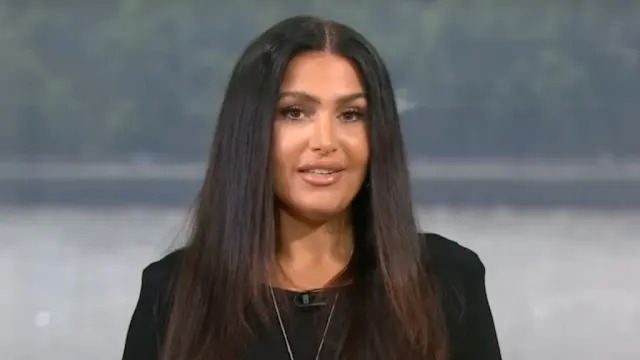

After nearly a decade as the face of First Take, Molly Qerim walked away from ESPN — and the story behind that decision is more layered than a simple “it was time to move on.”
On the surface, her Instagram announcement was gracious and professional. But beneath it sat a contract dispute, a pay gap, denied opportunities, and an exit that moved faster than she expected. This article breaks all of that down — clearly and honestly.
Molly Qerim’s Run at ESPN and What She Built on First Take
Qerim joined ESPN in the mid-2000s and worked across several shows, including SportsNation, before settling into what would become her signature role — moderator of First Take.
She spent roughly ten years in that seat. And it wasn’t a passive role. First Take is a high-energy debate show, and Qerim was the person keeping it on track every single day. She managed big personalities, steered conversations, and gave the show a sense of structure that it genuinely needed.
That context matters. Because when you understand what she contributed over a decade, the way her exit unfolded starts to feel a lot more significant.
She announced her departure via Instagram in September, ahead of her contract’s year-end expiration. According to Sports Business Journal, she had rejected ESPN’s renewal offer and would be leaving at the end of 2025.
What Molly Qerim and Stephen A. Smith Actually Said
Qerim’s Instagram statement kept things warm and measured. She described the experience as “one of the greatest honors” of her career and said she was choosing to “close this incredible chapter.” No blame, no drama — just a professional send-off.
But she did say one thing that stood out: the news “came out sooner than I intended.” That small detail tells you a lot. The timing wasn’t fully in her control. Something moved faster than she planned.
Stephen A. Smith addressed the situation on his SiriusXM show. He said Qerim “had some issues” he wasn’t going to get into, confirmed those issues were not with him personally, and used a phrase that caught a lot of attention — he said she “abruptly resigned.”
That word, abruptly, signals that the exit wasn’t a smooth, mutually agreed-upon wind-down. It was faster and messier than ESPN probably wanted. Reports noted that less than 24 hours after Smith mentioned her resignation publicly, she was no longer an ESPN employee.
Neither statement gave the full picture. That’s where the business side of the story comes in.
The Contract Offer She Called a Slap in the Face
According to multiple reports, ESPN and Qerim were “way off” when it came to renewing her deal. She reportedly found ESPN’s offer deeply insulting given her tenure — one source described her reaction as feeling it was a “slap in the face.”
An ESPN executive, quoted by Awful Announcing, put it plainly: “At the end of the day it was about money… plain and simple. She’s been on the show for 10 years so I guess she felt she deserved more.”
Reports suggest her salary was around $500,000 per year. That figure comes from secondary commentary sources, so treat it as reported rather than confirmed. But even as an estimate, the contrast is striking.
Stephen A. Smith, who also holds an executive producer role on First Take, reportedly earns around $21 million annually. That’s a widely reported figure and a useful point of comparison — not to suggest anything unfair on Smith’s part, but to show the financial gap between the show’s biggest name and the person running the room every day.
Think about it this way: imagine a senior team member who manages a flagship project for ten years, keeps everything running smoothly, and then gets offered a modest contract renewal with no raise and no new responsibilities. Meanwhile, others in comparable roles are earning far more. At some point, that offer stops feeling like a negotiation and starts feeling like a message.
That’s reportedly how Qerim received it.
ESPN Wouldn’t Give Her a Show of Her Own
Money wasn’t the only issue. Reports also indicate that Qerim pushed for her own show and broader opportunities within ESPN — not just a continued seat on First Take.
ESPN’s answer, according to multiple reports, was essentially: stay where you are. No new show. No expanded platform. Just the same moderator role she’d been doing for a decade.
From a business perspective, this is a classic talent retention mistake. When a proven performer asks for growth and the response is “we’d like you to keep doing exactly what you’re already doing,” the company is betting that person has no better options. It’s a risky calculation.
ESPN may have reasoned that First Take‘s brand was built around its debate format and around Stephen A. Smith specifically — not around Qerim’s individual presence. In other words, she was valuable, but replaceable. That calculation may have underestimated the cost of losing institutional knowledge and on-air experience that took years to develop.
She has since been replaced by Shae Cornette as host of First Take. The show continues. But what ESPN gave up — and what it communicated to other experienced talent in the process — is worth examining.
The “Lame Duck” Factor and the Timing of Her Exit
Here’s another angle that helps explain why things moved so fast. ESPN’s content chief, Burke Magnus, told The Athletic that both sides had already agreed Qerim would be removed from First Take when her contract ended at the close of 2025.
Sports commentator Chris “Mad Dog” Russo offered a theory: Qerim left early because she didn’t want to spend months as a “lame duck” host — someone whose exit had already been decided but who still had to show up and do the job anyway.
That’s a real and uncomfortable position to be in. Imagine being told you won’t have a role after year’s end, but being expected to perform at full energy for months while your replacement is quietly being arranged. Walking away early, in that context, isn’t impulsive. It’s a form of protecting your dignity.
Her own words — that the news came out “sooner than I intended” — suggest she had hoped to control the story a little better. Instead, it got out, and within a day, her time at ESPN was over.
What Her Exit Reveals About ESPN’s Talent Strategy
Qerim’s departure fits a broader pattern in sports media. ESPN has been navigating significant cost pressure for years, and the strategy has increasingly leaned toward investing heavily in a small number of high-profile names while managing everyone else as more replaceable costs.
That’s not necessarily a bad business strategy in isolation. But it creates a specific kind of environment — one where long-tenured, high-performing support talent can start to feel invisible. They run the show, in some cases literally, but the institutional investment flows elsewhere.
For anyone thinking about talent management — in media, in business, anywhere — this is a useful case study. Longevity alone doesn’t guarantee that an employee feels valued. And when a company responds to a veteran’s request for growth with a flat offer and a closed door, it often ends up losing someone it didn’t expect to lose.
If you’re interested in how media and business decisions like these play out at a broader level, Wise Business Guide covers these kinds of stories with the same practical lens.
What Happens Next for Molly Qerim
Since leaving ESPN, Qerim has largely kept a low public profile. There’s been one reported outside appearance, but no confirmed new show or network deal as of the latest available information. Some commentary has speculated she’s exploring her own independent venture, but that remains unconfirmed.
What she does have is name recognition, a decade of live television experience, and a demonstrated ability to manage some of the biggest personalities in sports media. Those aren’t small assets.
Former ESPN talent has landed at streaming platforms, podcast networks, radio, and independent media projects. Any of those paths would make sense for someone with her background. The question is whether she’ll step back into a high-visibility role quickly, or take her time building something on her own terms.
The Bigger Picture
Molly Qerim’s exit from ESPN wasn’t dramatic in a tabloid sense. There was no public fight, no angry interview, no scorched-earth statement. But underneath the professional surface was a straightforward breakdown: a ten-year contributor who felt undervalued, asked for more, got offered less, and left.
The business lesson here isn’t complicated. When talented people feel like their growth has hit a ceiling and their value isn’t being matched with real investment, they find the door. ESPN may have replaced the seat quickly — but replacing what Qerim actually brought to that show is a different question entirely.
You may also like: